Acquisition-State Reliability · Physics-Grounded · Imaging AI

You know when your scanners are failing.
Do you know when your AI is?

AI models do not read DICOM metadata — they read pixels.

Reconstruction conditions, dose drift, and slice thickness changes that standard metadata pipelines cannot detect materially affect what your model actually sees. GammaMetric characterizes the imaging environment your AI encounters — so you know when a study is inside or outside its validated envelope.

Sensitivity benchmarks tell you how a model performed during validation. GammaMetric tells you whether today's study resembles those validation conditions.

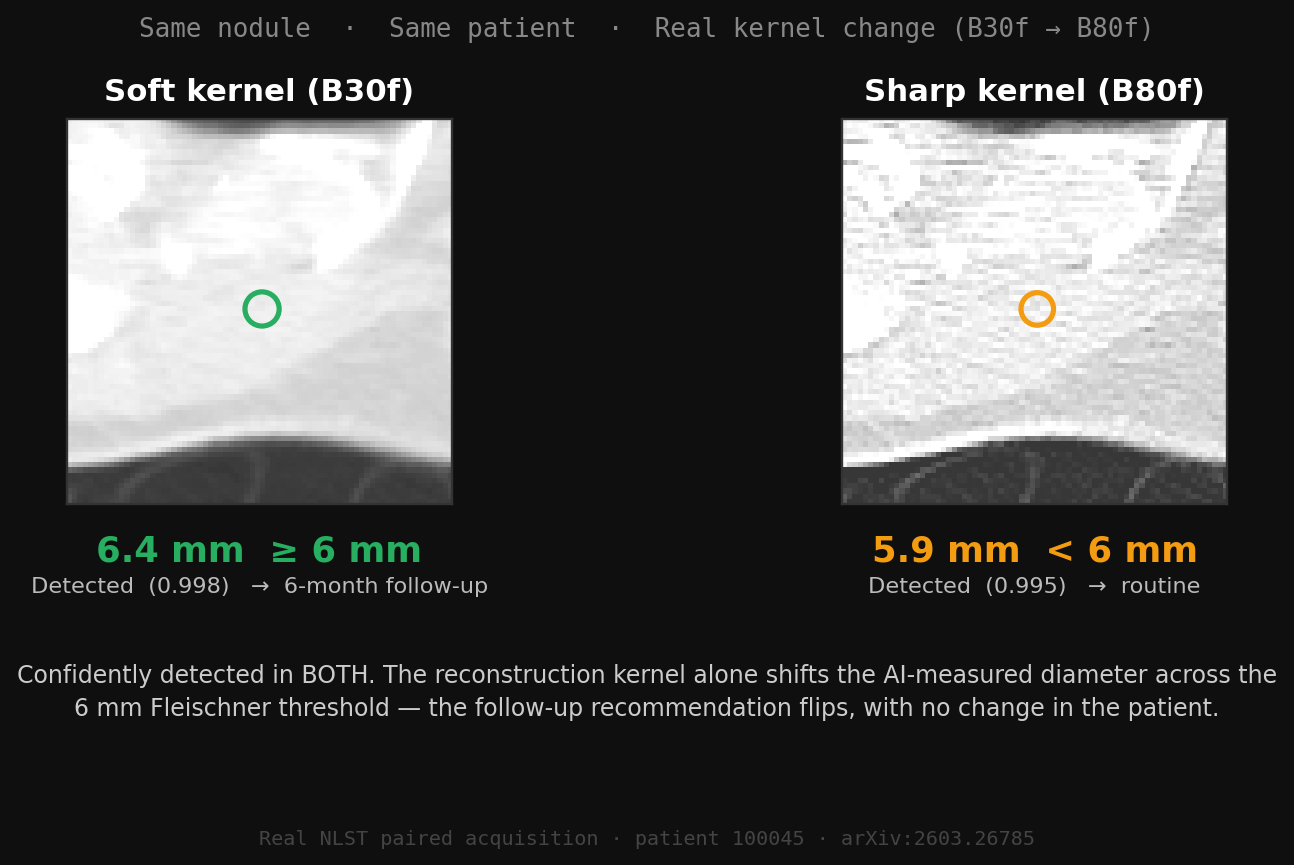
Real paired NLST CT: the same nodule confidently detected under both reconstruction kernels, but the kernel alone shifts the AI-measured diameter across the 6mm Fleischner threshold, flipping the follow-up recommendation
Credentials
Yale School of Medicine Diagnostic Physics Residency
ABR Board-Eligible Diagnostic Medical Physicist
Full Study Under Review — Academic Radiology
arXiv:2603.26785 — AI Sensitivity Preprint
Interval-to-Diameter Ratio Governs Reconstruction-Phase Sensitivity — Physics in Medicine & Biology (submitted)
154-Case LIDC-IDRI Perturbation Study
1 in 6 patients received a different Lung-RADS follow-up recommendation between full-dose and quarter-dose reconstructions of the same scan — even though the DICOM metadata was identical.
AAPM Mayo Clinic · Real Projection-Domain Data · n=45 · Replicated on LIDC-IDRI n=183
Deployment Monitoring

Should I trust this AI result
right now, with today's protocol?

Every study is scored against the model's characterized acquisition envelope. Two examples — the same engine, two different protocol states.

● Outside Reference Protocol  ·  Review Recommended GE Revolution · 3.75mm · B30f · 7.5 mGy
Estimated Robustness Moderate Expected performance change −9.3 pp relative to characterized baseline
Drivers
Slice thickness 3.75 mm  −8.1 pp Dose 7.5 mGy  −1.2 pp
Meaning  — This protocol falls outside the reference validation envelope. Performance may differ from benchmark testing.
● Within Characterized Range Philips IQon · 1.25mm · B30f · 9.0 mGy
Estimated Robustness High Expected performance change −0.5 pp relative to characterized baseline
Drivers
Dose 9.0 mGy  −0.5 pp
Meaning  — Protocol matches characterized validation conditions. Proceed normally.
Sample Report

What a reliability report
actually looks like.

Two independent instruments. One acquisition event. Image reliability and AI robustness scored separately — each grounded in published perturbation data.

View Full Report →
Capabilities

One reliability engine.
Two ways to use it.

AI vendors integrate it through a REST API or DICOM webhook — a per-scan reliability score before a result is surfaced. Health systems use it for continuous site monitoring — automated alerts when acquisition conditions drift outside the validated envelope. Same physics, same signal, different surfaces.

AI Vendors — Available Now

Reliability API

  • Per-scan reliability score via REST API or DICOM webhook — Image Reliability and AI Robustness scored independently
  • Physics-grounded characterization across kernel, slice thickness, dose, and reconstruction state
  • Pixel-based acquisition fingerprinting — detects conditions DICOM metadata cannot expose; FBP vs. iterative reconstruction reads identically in ConvolutionKernel (AUC 0.995 on phantom validation)
  • Methodology documentation suitable for FDA submission, post-market surveillance file, or quality committee review
  • Based on published research: arXiv:2603.26785, under review at Academic Radiology
Health Systems — Available Now

Site Reliability Monitoring

  • Passive Orthanc DICOM listener — every study classified automatically, no workflow change
  • Alerts when acquisition conditions drift outside the model's validated envelope — protocol drift caught before it becomes a patient safety event
  • Per-study acquisition record: parameters, reliability tier, full timestamped audit trail
  • Designed for post-market surveillance, Joint Commission QA, and CHAI AI governance programs
  • Answers the question regulators are starting to require: is your AI operating as validated at this site, with these protocols?
Site dashboard — coming soon
Also Available — Free Tool
CT Dose Analytics & Leapfrog Reporting
Leapfrog Section 8B, ACR DIR benchmarking, protocol outlier detection. Free at dose.gammametric.com.
Try It Free →
Who Uses GammaMetric

Not one audience.
One platform.

AI Developers
Reliability API + robustness characterization
Characterize your model's acquisition envelope before submission. Document robustness across kernel, dose, and vendor variation for FDA post-market files.
Hospitals
Site monitoring + reliability reports
Continuous acquisition monitoring and automated email alerts when protocol conditions drift outside the model's validated envelope. Audit trail included.
Imaging CROs
Protocol-induced variability quantification
Separate acquisition-induced measurement variability from biology in multi-site trials. Quantify which protocol differences explain outcome variance across sites.
Researchers
Acquisition-state characterization + CT dose analytics
Physics-grounded acquisition coordinate for multi-site imaging studies. Free CT dose tool for ACR DIR benchmarking and Leapfrog compliance.
The Problem

AI models are validated in one imaging environment
and deployed into another.

The gap between validation conditions and real-world deployment is where AI performance quietly degrades — and where accountability belongs to whoever ships the model.

01

DICOM Metadata Is Not Enough

ConvolutionKernel reads identically for FBP and iterative reconstruction on major scanners. Slice thickness varies across sites. Dose drifts without notice. Standard pipelines are blind to acquisition conditions that materially affect model performance.

02

Vendor Benchmarks Don't Reflect Deployment

FDA clearance is tested at controlled dose levels and standard protocols. Real-world sites run lower doses, thicker slices, and varied reconstruction. The gap between "cleared" and "deployed" is rarely measured — until now.

03

Failures Get Blamed on the Model

When acquisition conditions push a study outside the validated envelope, the AI result is unreliable — but the model gets blamed. GammaMetric quantifies which studies are operating outside that envelope before a result is surfaced.

Integration

One API call.
Before you surface a result.

GammaMetric runs passively in your pipeline. Every study gets scored before your AI result is surfaced — your system decides what to do with the signal.

01

Send the Study

Forward DICOM headers (or pixel data) to the GammaMetric API via webhook or REST. Only acquisition parameters and pixel patches are used — no PHI transmitted, no image storage.

02

Get a Reliability Score

Each study is scored against your model's characterized acquisition envelope. Slice thickness, kernel, dose, and reconstruction state are all assessed. You get a robustness score — Within Characterized Range, Review Recommended, or Outside Envelope — plus expected performance change relative to baseline.

03

Your System Decides

Show the result. Suppress it. Flag it. Route it to secondary review. GammaMetric returns the signal — you own the decision. No clinical logic baked in, no radiologist-facing UI required.

On Demand

PDF Reliability Report

Generate a site-specific reliability report from any study — acquisition profile, robustness characterization across kernel, dose, and slice thickness, and protocol observations. Suitable for post-market surveillance documentation.

Request a Demo →
Also Available

CT Dose Analytics

Self-serve CT dose monitoring at dose.gammametric.com. Leapfrog Section 8B reporting, ACR DIR benchmarking, drift alerts. Free to use.

Try It Free →
CT Dose Analytics — Features

Everything the free tool
includes

Compliance

Leapfrog Section 8B Reporting

Median DLP for routine head and abdomen-pelvis CT across all five Leapfrog pediatric age groups (<1, 1–4, 5–9, 10–14, 15–17) — formatted and ready for Section 8B reference.

Benchmarking

ACR DIR Benchmark Comparisons

Your facility's dose percentiles compared against ACR Dose Index Registry national reference levels. Clear status flags — Excellent, Acceptable, or Above Benchmark — for every body region.

Quality

Outlier Detection

Automatic identification of exams with unusually high DLP — repeat acquisitions, wrong protocols, or multi-phase studies — with transparent methodology notes for your physics team.

Optimization

Protocol Observations

Physicist observations on protocol consistency, scanner variability, and dose reduction opportunities — useful context for your quality improvement program beyond compliance reporting.

Trend

Dose Trends Across Reporting Period

Dose trends visualized across your full reporting period. Identify protocol changes, scanner drift, or technologist variability — supporting ongoing QA program development beyond Leapfrog season.

Deliverable

Professional PDF Report

Publication-quality output with percentile tables, benchmark charts, methodology documentation, and your facility name — suitable for quality committee presentation or Leapfrog submission reference.

Context

The performance gap
is measurable

GammaMetric's own pilot study quantifies how acquisition variability affects imaging AI — and why protocol optimization matters beyond compliance.

1 in 6

Patients who receive a different AI-derived Lung-RADS follow-up recommendation between full-dose and quarter-dose reconstructions of the same scan (n=183, LIDC-IDRI; replicated on real projection-domain data, AAPM Mayo).

~19pp

Sensitivity drop at 5mm slice thickness versus standard. The gap between your protocol and the vendor's validation conditions is rarely measured.

0.995 AUC

Domain separability between FBP and iterative reconstruction on phantom data — with identical DICOM ConvolutionKernel tags. Standard metadata pipelines cannot detect this condition. Pixel analysis can.

Get Started

Interested in piloting
GammaMetric?

We're working with a small number of AI vendors and health systems to run pilots. If you're validating an AI model, deploying into multi-site environments, or building post-market surveillance infrastructure, we'd like to talk.

AI Vendors

Robustness characterization + API access

Characterize your model's acquisition envelope across kernel, dose, slice thickness, and vendor. Receive a physicist-reviewed report suitable for regulatory documentation. API access for per-scan scoring in production.

Request a Demo →
Health Systems

Site monitoring pilot

Passive DICOM listener on one scanner. Every study scored automatically. Email alerts when acquisition conditions fall outside the validated envelope. Full audit log. No workflow change required.

Request a Pilot →
CT Dose Analytics is free and self-serve — no pilot needed.
Try dose.gammametric.com →
FAQ

Common questions

What does a reliability report contain?
Two independent assessments per study: an Image Reliability score (acquisition-induced measurement variability, contributing factors, expected diameter range, Lung-RADS threshold impact) and an AI Robustness score (protocol-level estimate of model response stability, characterized under kernel, slice thickness, dose, and vendor variation). Both are grounded in published perturbation experiments — not heuristics. View a sample report.
What does an AI robustness characterization cover?
GammaMetric characterizes how a model's outputs shift across clinically realistic acquisition variations — reconstruction kernel, slice thickness, dose level, and vendor. The result is a protocol-level robustness profile: which acquisition conditions produce stable outputs and which produce elevated response instability. This is characterization, not failure prediction — it tells you where your model's validated envelope ends.
Is my data secure?
For AI monitoring: only acquisition parameters and pixel patches are transmitted — no PHI, no image storage. For CT dose analytics: de-identifying patient data before sending is strongly recommended. No raw data files are retained after analysis is complete.
What data format do you accept?
For AI monitoring: DICOM headers or pixel data via REST API or webhook. For CT dose analytics: CSV exports from Radimetrics (Bayer), DoseWatch (GE), or any dose monitoring system. Common column naming conventions are auto-detected — non-standard formats are welcome.
What Leapfrog section does the CT dose tool cover?
Section 8B: Pediatric Computed Tomography (CT) Radiation Dose. This requires reporting median DLP for routine head and abdomen-pelvis CT across five pediatric age groups. Reports provide exactly those data points, plus adult CT analysis as a value-add for your quality program.
Is this a replacement for a medical physicist?
No. CT dose reports include review by a diagnostic medical physicist, and the AI robustness characterization methodology is physics-grounded. But final interpretation, regulatory compliance, and clinical protocols remain the responsibility of your institution and its qualified physics staff.
How are dose benchmarks determined?
Dose percentiles are compared against ACR Dose Index Registry (DIR) national reference levels, maintained and updated by a diagnostic medical physicist to reflect current national practice.
Contact

Let's talk about
your deployment.

15-minute call. No pitch deck — just your model, your sites, and whether GammaMetric fits.

dan@gammametric.com →